
Growing Up Doesn’t Stop for Tragedy: ’Don’t Say Good Luck’ Review
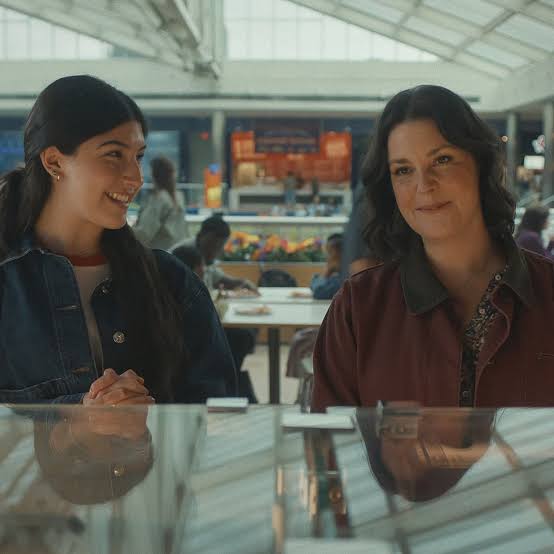
Excitement that comes at the wrong time is what 16-year-old Sophie Birenbaum finds herself facing in Julia Hart’s new feature film, Don’t Say Good Luck. The film explores what it means to face a life-changing reality while still trying to navigate the ordinary challenges of being a teenager. There is good news to be excited about, but that news comes just after Sophie discovers that her mother is sick. Suddenly, she has to find a way to hold on to her excitement while dealing with the fear and uncertainty that comes with knowing her family is about to change. Through Sophie’s experience, Don’t Say Good Luck explores growing up, family, love and the difficult process of continuing to live your life when something painful is happening around you.
One of the film’s strengths is that it does not allow Sophie’s mother’s illness to completely define her. Even while worrying about her family, Sophie is still given room to experience the ordinary parts of being a teenager. She has a crush on Jack, kisses him, tells her friend about it, gets excited about performing and even gets a little reckless by getting drunk. The film wisely refuses to let her mother’s illness completely take over her teenage life. Sophie can worry about her family while still enjoying the things that matter to her at that age, which makes her feel like a real young person dealing with something she is not prepared for.
However, it is slightly strange that we barely see Sophie’s everyday life at school. We see her in class, but only briefly, and most of her time is spent at home, with her friend or in the theater. Because Sophie is still a high-school student, more of her life as a student—through lessons, classmates or the ordinary worries that come with school—could have given us a fuller picture of who she is outside her family and performing. The theater is clearly an important part of her life, but school feels like an underdeveloped part of her world.
Sophie’s relationship with her mother is another major strength. The chemistry between them is undeniable and beautiful to watch, and they feel believable as mother and daughter. Sophie’s mother understands her daughter remarkably well. She knows her strengths and shortcomings, and because of that, she knows the right ways to encourage and push her. The words she keeps telling Sophie about believing in herself and knowing that she is capable of doing things are especially meaningful. They are the kind of words that can speak to anyone who has ever felt like they are not enough or not ready. For parents, the film also offers an important lesson: you cannot always know how to help your child if you do not know your child first. Sophie’s mother understands who she is, and that understanding allows her to support her in a way that actually reaches her.
The changing family routine effectively communicates how much their lives have shifted as Sophie’s mother’s illness becomes worse. At the beginning, her mother is the one waking the children up. Later, Sophie takes over that responsibility while her father helps around the house. It is a simple change, but it communicates how much their lives have shifted. The mother’s absence becomes visible through the things she can no longer do, and seeing the family adjust to this new reality is heartbreaking.
The way the family’s home is arranged also helps establish their life. From the beginning, it is clear that the first room we see belongs to children because of the things around it, from the furniture and other materials to the way everything is arranged. The childhood photographs help establish that this is a family that has been living together for years, while the different photographs make it easy to tell that there is more than one child. The house also feels lived-in, with everyday objects and clothes that do not look brand new or carefully placed just for the camera.
The contrast between Sophie’s home life and her time in the theater is particularly effective. When she performs in Waitress, the lighting becomes brighter and warmer, giving those scenes a different energy and reflecting the excitement she finds on stage. At home, the film looks more natural and less polished, which works well for the family’s everyday life.
I say this all the time, but I really love it when films allow darkness to be darkness, night to be night and day to be day. I find it difficult to fully immerse myself in a film when artificial lighting constantly reminds me that I am watching something constructed. Don’t Say Good Luck does not fall into that trap. There are moments when the film simply allows the darkness to exist naturally, and that choice works beautifully. In particular, when Sophie and her mother are standing outside after their family celebration, the darkness around them feels like actual night rather than a scene that has been excessively lit for the camera.
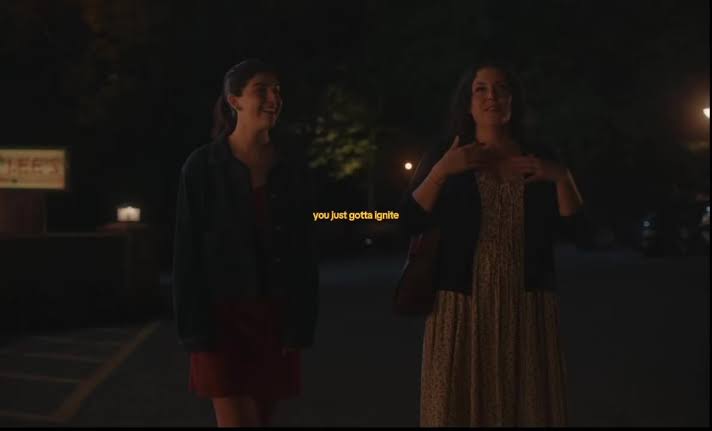
The camera work is also effective. Close-up shots capture emotions, while over-the-shoulder shots help during conversations between two or more characters. Wider shots allow us to see the characters within their surroundings and establish the settings around them. These choices support the story without becoming distracting.

Sound is another element that works particularly well, especially the actors’ voices. Melanie Lynskey and Sunny Sandler stand out because their voices feel natural. They do not constantly speak loudly as though they need to make sure every word reaches the audience. Sometimes speaking too loudly can take away from the emotion of a scene, but their delivery often feels more genuine because it is not forced.
The background voices at school also add another layer of realism to the setting. When there are many people in one place, it is almost impossible for it to be completely quiet, so hearing those voices in the background helps the school feel believable.
The singing is another highlight. The actors’ voices are absolutely beautiful, and as someone who loves music, I could listen to them every day.
The performances overall are good, although they are not perfect. The chemistry between Sophie and her mother is one of the film’s highlights, and the supporting actors also do a good job. However, there are moments when Sophie’s performance needed more emotional weight.
One example is when she finds out that she got the lead role. Her complicated reaction makes sense because she has just discovered that her mother is sick. Still, the moment feels emotionally underplayed. She wanted Dawn and ended up getting Jenna, a role she did not even expect to get, so the news should carry greater emotional weight. Her smile does not quite communicate that significance, and even the way she later tells her parents feels slightly underwhelming.
There are also moments when the narrative expects the audience to understand things too quickly. For example, Sophie calls her friend and simply says that “it came back,” and her friend immediately understands what she means. It is possible that they had discussed it before, but the audience is not given enough context to understand how her friend knows exactly what Sophie is referring to. A little more information could have made that moment feel more natural.
The screenplay also relies on some unnecessary repetition. At first, the butt-dial storyline works. It establishes that Sophie’s father is someone who constantly butt-dials people, and it provides a way for Sophie to discover information she was not supposed to hear. But the film keeps returning to it, from Sophie discovering bad news through a butt dial to later hearing her parents laughing through another one. Eventually, the device becomes too repetitive. The idea is clear, but the screenplay could have found a more subtle way to communicate the same information.
The driving lessons are another example. They are mentioned repeatedly and brought up here and there until they begin to feel more important than they actually are. The film could have mentioned them less without losing anything from the story.
The title is perhaps one of the film’s weaker choices. Don’t Say Good Luck does not feel strongly connected to the film, and even after finishing it, its significance remains unclear. A title does not have to explain an entire film, and something too predictable would not necessarily work either. But a title that captured more of the emotional heart of the story—family, growing up, love, fear, encouragement and trying to continue living your life while knowing that something is changing—might have been more fitting.
Ultimately, Don’t Say Good Luck understands that growing up does not stop when life becomes difficult. Sophie is allowed to worry, fall in love, make mistakes, perform, celebrate and still be a daughter trying to understand what is happening to her family. Despite some narrative choices and emotional moments that could have been handled better, the film’s strongest moments come from this balance, particularly in the relationship between Sophie and her mother.